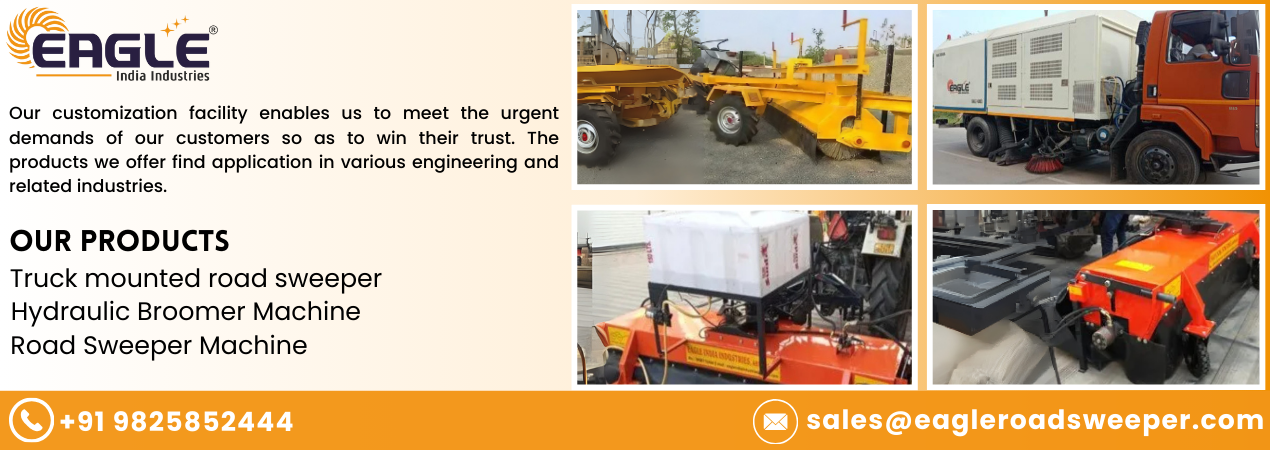
Introduction to Road sweeper truck
A Road sweeper truck is a specialized heavy commercial vehicle designed to keep urban and highway infrastructures clean. These self-propelled units are essential for municipalities and large contractors in India, where managing dust and road debris is a constant challenge. Unlike smaller sweepers, these trucks are built on reliable chassis such as Tata, Eicher, or Ashok Leyland, ensuring they can travel long distances and carry large loads of collected waste. They are engineered to deliver high-performance cleaning while maintaining traffic safety standards. Discover robust models at the Eagle Roadsweeper website.
Working Principle and Process Flow
The core of a Road sweeper truck is its dual-engine configuration. The primary engine drives the truck, while a dedicated auxiliary engine powers the sweeping components—vacuum fans, brushes, and hydraulic pumps. As the truck moves, curb brushes sweep debris into the center, where a powerful nozzle sucks it into a sealed hopper. A complex filtration system separates air from dust, ensuring clean air exhaust. Water spray bars located at the front and near the brushes suppress dust clouds, making these trucks environmentally compliant. Learn more about the mechanics at the Eagle Roadsweeper portal.
Types of Road sweeper trucks
- Vacuum Road Sweeper Trucks utilizing suction power for fine dust removal, ideal for city roads and leafy avenues.
- Mechanical Broom Trucks employing a conveyor belt system to lift heavy debris like stones, sand, and construction waste.
- Regenerative Air Sweepers that blast air into road cracks to dislodge stubborn dirt before vacuuming it up.
- Compact Sweeper Trucks built on smaller chassis (LCV) for navigating narrow city lanes and congested market areas.
- Highway Sweeper Trucks designed for high-speed cleaning with arrow boards and crash attenuators for safety.
Key Features and Specifications
- Hopper capacities ranging from 4 to 10 cubic meters, reducing the frequency of dumping trips.
- In-cab control panels allowing the driver to adjust brush speed, water flow, and suction pressure instantly.
- Left and right-hand side sweeping capabilities to clean medians and curbs without driving against traffic.
- High-pressure wandering hose attachment for cleaning catch basins, footpaths, and areas hard to reach by the truck.
- GPS tracking and camera systems for monitoring cleaning routes and ensuring operator accountability.
Applications of Road sweeper truck
- Municipal Corporations use these trucks for daily night sweeping of main arterial roads to ensure a clean city by morning.
- National Highway Authority of India (NHAI) contractors deploy them to maintain expressways, removing tire shreds and accident debris.
- Large Industrial Complexes and SEZs utilize them to control fugitive dust emissions and maintain internal logistics roads.
- Airport Authorities rely on specialized sweeper trucks to keep runways free of Foreign Object Debris (FOD) for flight safety.
Benefits of Using Road sweeper trucks
- Drastically reduces the manual labor workforce required for cleaning long stretches of road, lowering injury risks.
- Ensures consistent cleaning quality regardless of operator fatigue, unlike manual broom sweeping.
- Improves air quality by trapping fine dust particles (PM2.5 and PM10) instead of kicking them into the air.
- Enhances road safety by removing slippery sand and hazardous debris that can cause skidding accidents.
Top Manufacturers and Suppliers in India
The manufacturing landscape for Road sweeper trucks in India is robust, with several key players offering indigenous and collaborated technologies. Suppliers often build the sweeping superstructure on customer-preferred chassis brands to ensure easy vehicle servicing. Hubs in Gujarat and North India are prominent for these assemblies. Manufacturers provide extensive training for drivers and operators, as the effectiveness of the machine depends heavily on correct usage. Buyers should look for suppliers who offer readily available spare parts for the sweeping unit, such as suction hoses, nozzles, and filters, to minimize downtime.
Maintenance and Safety Tips
- Perform daily checks on the auxiliary engine oil and coolant levels before starting the shift.
- Clean the dust filters and cyclone separators after every operation to maintain maximum suction power.
- Inspect the sweeping brushes for wear and adjust the down-pressure to avoid damaging the road surface.
- Wash the hopper interior thoroughly to prevent corrosion and hardening of collected wet debris.
- Ensure all warning lights, beacons, and reflective tapes are clean and visible for night-time operation safety.
FAQs – Road sweeper truck
Contact Details
Talk to our specialists today for tailored solutions and fast assistance.